
Common law claims
Can I resign while I am on WorkCover in Queensland?
While you are on workcover, your employment status may change. It’s important to appreciate that these changes may affect your workers’ compensation entitlements. In this article we address the scenarios we get most commonly asked about. If you want to learn more about common law damages claims after a workplace accident, we have a detailed guide on that topic too.

Written and reviewed by Oszkar Denes, personal injury lawyer
READ MORE ABOUT ME HERE ›
Resignation
In Queensland, while you are on WorkCover, technically nothing stops you from resigning from your employment. Even after you resign you continue to be entitled to workers’ compensation benefits.
However, if you resign from work without any particular reason, especially within the first 12 months after your injury, you should be aware of the following:
- You will still need to provide WorkCover Queensland with medical certificates on a regular basis to prove that you remain incapacitated to work.
- The main objective of WorkCover Queensland is to get you back to work. As soon as your condition improves sufficiently, Workcover Queensland will try and organise work involving suitable duties or light duties. (This means that the tasks you undertake at work match your physical limitations, or that you work shorter days than you otherwise would have.) One consequence of resigning from your normal employer is that when WorkCover Queensland organises suitable duties, this will necessarily be with a host employer. This is a different company, in a role which with which you will be completely unfamiliar. If you had not resigned, WorkCover Queensland could have possibly made arrangements with your normal employer to get you back to work at your normal workplace in a suitable role.
For these reasons, from a practical perspective, resigning from work while you are on workcover is generally only advisable if the resignation is based on medical grounds and advice. We recommend that if you intend to resign, seek legal advice first.
Read below about our 25% fee cap. We’d be happy to discuss your situation. Please reach out to us here.
Getting a new job while on WorkCover
If you get a new job, you may still be eligible for payment of your medical and rehabilitation expenses but your workers’ compensation entitlements will likely change. Please note the following:
- You must tell WorkCover Queensland within 10 business days that you have found new work. If you don’t, this may be considered fraud. The Workers’ Compensation Regulator may prosecute you, you may face criminal penalties and you may lose your rights for compensation and common law damages.
- You must tell WorkCover Queensland how much you earn in your new position. This will lead to a recalculation of your weekly wage payments.
- Tell Workcover Queensland what your duties are in your new job. Why is this important? If you previously told Workcover Queensland that there are certain tasks or activities that you were not able to perform due to your injury, but now in your new role you are performing some or all of those activities then there is a possibility that Workcover Queensland will come after you on the basis that you have made misleading statements. This can have serious consequences.
- You should tell your new employer if your injuries negatively impact your ability to undertake any of your tasks in your new job. Otherwise, if you aggravate your injuries in your new job, this could have a negative impact on your workers’ compensation entitlements and also on any future potential common law damages claim which you could otherwise make. (We understand that some employers tend to discriminate against prospective employees who have a “workcover history”. It is still important that you are aware of the consequences if you don’t disclose your previous injuries.)
Employer can’t dismiss you within 12 months
The employer cannot dismiss you from your job within the first 12 months after your injury solely or mainly because you are not fit for employment because of your injury.
If you are dismissed from work, you are able to apply for reinstatement within 12 months after the injury. You will need a medical certificate that shows that you are fit to be reinstated in your former position. If the employer refuses to reinstate you, you can apply to the industrial commission, which can make a reinstatement order.
Unfortunately, after the 12 months have lapsed, the employer is able to terminate your employment.
Unfair dismissal
If you lose your job after a work injury, in some circumstances you can bring an unfair dismissal claim against the employer. If you settle your unfair dismissal claim, be very careful and make sure the settlement doesn’t stop you from later bringing a common law damages claim. We have seen examples where the employer tried to settle the unfair dismissal claim and also include a clause in the settlement agreement which would have prevented the injured worker to pursue common law damages for injuries suffered at work.
What if the employer has found someone else to replace me while I am on workcover?
If the employer does this within the first 12 months after your injury, then they can only employ a replacement worker if they give notice to that worker of the temporary nature of their employment and of your right to return to your work. In other words, you are still able to return to your normal position.
What happens to my workcover claim after I am dismissed from my work?
If your employer has dismissed you from your work, your workers’ compensation entitlements continue. This means you continue to receive your weekly payments from WorkCover Queensland and they also continue to pay your medical and rehabilitation expenses.
When you are fit to return to suitable duties, WorkCover Queensland will make arrangements with a host employer (i.e. a company other than your normal employer) so that you can work with that company in a suitable role.
Please note, if you are dismissed from work, it is important to check that the employer has given you the required notice period and that all your entitlements including annual leave, long service leave etc have been paid out.
Redundancy
It is possible for the employer to make your position redundant. This is possible even within the first 12 months after your injury. However, it has to be a genuine redundancy. In other words, the employer must be able to show that your position itself became redundant.
Further, the employer must provide you with the necessary notice and ensure that you receive any redundancy pay as well as all other outstanding payments

simple client agreement
25% cap on professional fees
In most personal injury matters, we offer to cap our professional fees at 25% of all inclusive settlements.
We don’t charge uplift fees and you don’t have to pay any expenses upfront.
There are some situation in which the 25% fee cap does not apply. Read our clear explanation below.
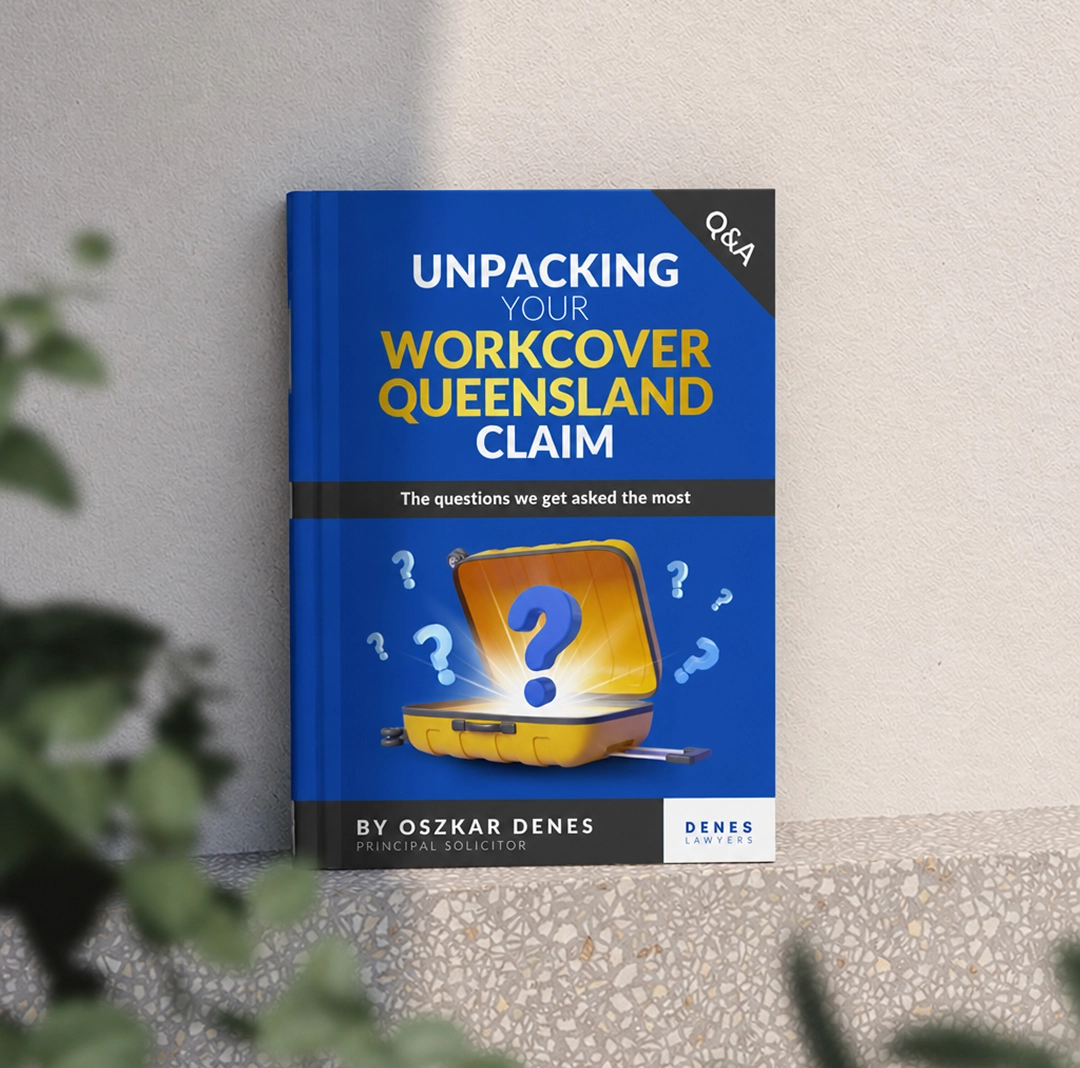
Free book: what to expect when you make a workers' compensation claim in Queensland
If you have been injured in a work accident in Queensland, understanding your rights and the WorkCover process can feel overwhelming.
Our free hard copy book, Unpacking Your WorkCover Queensland Claim, gives you clear, practical guidance. It covers many of the questions we get asked, including:
- What are the steps in a workcover claim?
- Statutory claim vs common law claim
- What if the claim is rejected?
- What to do if the impairment assessment result is too low
- Common law claim process
- Our No Win No Fee agreement
Fill out the form below to receive your free copy. You don’t need to be a client to receive a copy.
Every client and case is unique—we’re here to help you make the right legal decisions.
Prefer to speak with someone directly?
Call us on (07) 3063 2268 and we’ll be happy to discuss your matter.
Contact us
Just fill out the form below. Please remember: anything you share with us is strictly confidential and will never be disclosed to anyone without your consent.
"*" indicates required fields
Frequently asked questions
Can I resign if I am on workcover?
Yes, you are entitled to resign from your job. However, to ensure you continue to receive your workers’ compensation entitlements, you will still need to ensure that you obtained medical certificates that prove you remain incapacitated to work. We also recommend seeking legal advice (see above for more details.)
Can I change jobs while on WorkCover?
Yes you can. You should update WorkCover. After you start your new job, WorkCover will likely adjust your weekly compensation amount.
I went on WorkCover. Can the employer dismiss me?
Within the first 12 months following your injury, the employer can’t dismiss you solely or mainly because of your injury. So this is not an absolute prohibition, but the employer has very limited rights to dismiss you during this initial period. After the first 12 months, workers’ compensation laws don’t stop the employer from dismissing you – but of course they still have to comply with other industrial laws.
Note that unfortunately you can still be made redundant even in the first 12 months – but it has to be a genuine redundancy.
If I make a claim for unfair dismissal, can I later seek common law damages?
Yes, but make sure when you settle your unfair dismissal claim, the settlement agreement does not include a clause that prevents you from bringing a separate common law damages claim. We have a separate article about this, see above.