
No Win No Fee
No Win No Fee lawyers Queensland
Most personal injury law firms in Queensland offer no win no fee agreements—but not all agreements are the same. At Denes Lawyers we represent each client on a No Win No Fee basis. This means you don’t have to pay any fees or expenses until your claim is resolved, either by way of settlement or judgment. In most cases we can cap our professional fees so that our fees don’t exceed 25% of your settlement.
On this page

Introduction to legal costs
When you engage a lawyer, you sign a cost agreement. It’s a contract. It sets out the work which your lawyers will carry out on your behalf. It also explains how legal costs will be calculated.
No Win No Fee is a type of cost agreement which is commonly offered in personal injury claims. Its main benefit is that you don’t have to pay legal costs upfront, and if your claim fails, your lawyer can’t charge you for their work.
If your claim is successful, then you have to pay legal costs from your settlement. Each firm in Queensland offers different No Win No Fee agreements. If you sign a bad agreement, you could end up paying too much in legal costs. You could lose thousands (or tens of thousands) which you could otherwise have saved.
In this guide we explain how you can keep legal costs at a reasonable level.
What legal costs are involved in a personal injury claim?
There are two main types of costs in a claim:
1. Professional fees
These are the fees your lawyer charges for the work they perform on your claim.
Professional fees can be calculated by reference to the hours spent on your matter. Alternatively, some lawyers charge a flat fee for specific tasks. There may be further alternatives as well.
2. Disbursements
Disbursements are out-of-pocket expenses required to run your claim, such as:
- Medical reports (often several thousand dollars per report)
- Court filing fees
- Barrister fees
- Expert evidence
These costs can add up quickly and are often overlooked when people first sign a cost agreement.
What does “No Win No Fee” mean?
With Denes Lawyers, a no win no fee agreement means you don’t pay anything unless you receive compensation. (Be aware though, some firms which offer no win no fee deals still make you pay disbursements upfront – see further below).
If your case settles or you win, your legal fees are paid at the end of the claim out of your compensation.
You should know that each lawyer has their own no win no fee agreement – and there can be big differences! For example:
- some lawyers make you pay expenses upfront
- there are lawyers who say they have a right to stop working for you if they feel your claim has risks and they can still charge you for their work completed up to that point.
No Win No Fee agreements are not risk free. For example, if your claim goes to trial and is unsuccessful, then even though you may not have to pay your own lawyer’s fees, but the judge can order you to pay some of the defendant’s legal costs. This can be significant. This is why it’s important to choose a firm which:
- gives you written legal advice which clearly explains the risks in your claim
- has a successful track record
At Denes Lawyers we provide multiple written advices throughout the life of your claim. Each of these advices explains in plain English the strengths and weaknesses of your case. We don’t sit on the fence – if we think there are problems, we tell you so that you can make an informed decision about your claim.
What’s the maximum that a lawyer can charge in a personal injury claim?
In Queensland, the maximum professional fee which a lawyer can charge you in a claim is 50% of your settlement, after disbursements are deducted. Many firms still charge this much.
This doesn’t mean that lawyers can automatically take a 50% share because the legal bill must be reasonable and it must be based on the work which has been carried out. Still, we have seen many cases in which firms reach the 50% maximum, especially if they also charge uplift fees (see below).
Uplift fees (a hidden fee to watch out for)
Some firms in Queensland charge an uplift fee. We don’t. (And our costs agreement specifically states this.)
An uplift fee allows the lawyer to increase their invoice amount. Say the your legal bill comes to $50,000. If your lawyer charges an uplift fee, they can increase the bill amount to $62,500 (extra 25%). That’s $12,500 which comes out of your pocket.
When you do your research to find the right lawyer, make sure to choose one who doesn’t charge an uplift fee.
Our 25% fee cap – keep more of your compensation
In Queensland, most personal injury claims are resolved by settlement, for an all inclusive lump sum compensation. Our 25% fee cap means that although our professional fees are not based on a percentage of your settlement, they can’t exceed 25% of the settlement amount. (In other words, fees can be less.)
In some cases, we do not offer a 25% fee cap. These are:
- medical negligence claims
- if you change lawyers
- if your claim goes to trial, you win and the judge makes a costs order in your favour (i.e. the defendant has to contribute to your costs
How to choose a lawyer?
Here are some tips on how to select a lawyer:
- Make sure the lawyer who acts for you specialises in personal injury matters. If they run a general practice (meaning they practice in multiple areas of law), they may not be suitable for your needs.
- Try and meet a few different lawyers. The claim process will take at least a year (often longer) and you will need to speak with and meet with your lawyer from time to time, so you want to make sure that you can get along with them. When you meet a lawyer, it doesn’t hurt to take a family member with you to the meeting.
- Take your time to understand all fees and charges.
Illustration: how capped fees save you money *
Say a claim settles for $230,000 all inclusive. Let’s assume disbursements (out of pocket expenses) amount to $38,150. Have a look at how much you take home if fees reach 25% but are capped at that level.

What happens if you sign an agreement with a different firm that may charge up to 50% in professional fees. In this example, you receive just under $40,000 less in the hand
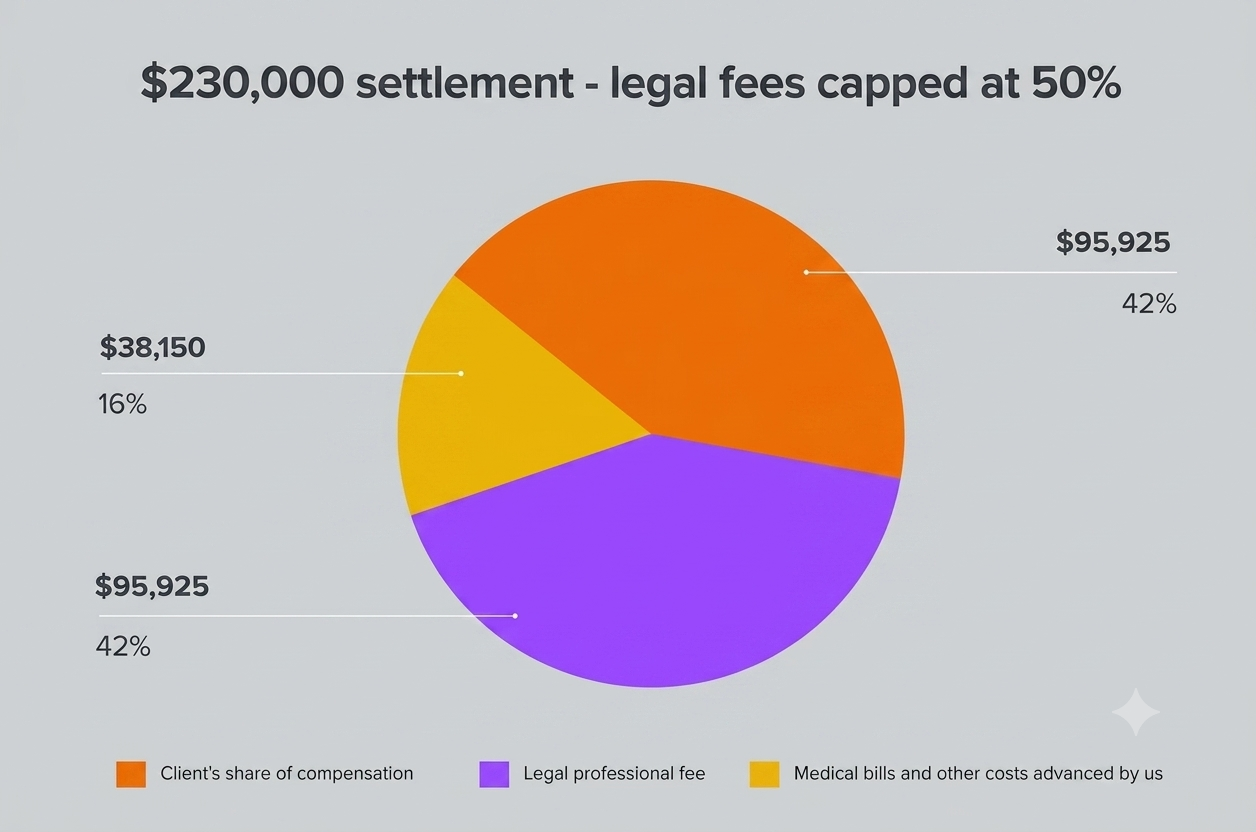
Please note: this is a hypotetical example. Each claim is different. In some cases the savings (i.e. any extra amount which you receive in the hand) may be less than what is shown above.
The difference in fee structure can significantly affect the compensation you keep:
| Feature | Denes Lawyers | Some other firms |
|---|---|---|
|
Legal fees |
25% capped |
Can be high (up to 50%) |
|
Uplift fee |
Not charged |
Often charged |
|
Upfront costs |
None |
Sometimes required |
|
Disbursements |
We cover |
Client may pay |
Oszkar’s perspective…
Delivering quality at a fair price
Over the years I have noticed something interesting: Many of our clients come to us after they first speak to friends or family who have been through the claims process before. After hearing about high fees and impersonal service at some large firms, they choose us for personal attention and better value.
How can we offer better value but not compromise on service quality?
I don’t sign up every claim This allows me time to pay attention to each one of our matters.
I work on each matter from start to finish I might delegate certain tasks, but I do the important bits (for example advising you, and running the negotiations)
Low overheads I don’t use billboards and I don’t advertise on TV. I don’t have to pass on these costs to my clients.
Frequently asked questions about No Win No Fee Agreements
What is an uplift fee?
We don’t charge uplift fees but some firms still do. An uplift fee allows a law firm to increase their legal fee by as much as 25%. It works like this. Imagine you legal bill is $10,000. The firm then uplifts its fee, and sends you a final bill for $12,500.
What percentage do no win no fee lawyers take in Queensland?
Lawyers can’t take a percentage of your settlement. Fees must be based on work done on the matter. The maximum fees which firms can charge can’t exceed 50% of your settlement. Unfortunately many firms end of up charging this much, especially if they also charge uplift fees. At Denes Lawyers, we charge (in professional fees) a maximum of 25% of the settlement.
I am not happy with my current lawyer. If I change lawyers, do I have to pay my current lawyer even though I haven't received any compensation yet?
If you engage new lawyers, you may be able to delay paying your current lawyers until after your claim settles. If you contact us, we will first review your client agreement and then take you through the process step by step. We recommend that before you decide to change lawyers, seek legal advice first. You should know that while you may have a right to change lawyers, your previous lawyer may be entitled to charge you now for their work, even if your claim has not settled yet.
Is there a cooling off period?
Yes, the minimum cooling off period is 5 days.
Can I still owe money if I lose?
In some cases – yes. This would apply if you take your claim to trial, you lose and the judge orders you to pay the defendant’s costs. In terms of your own lawyer though – they shouldn’t be able to charge you for their fees and expenses if your claims is unsuccessful.

Free book offer: what to expect in your injury claim
Many firms try to rush you to sign up with them without carefully considering your options. We encourage you to first learn about your personal injury claim. You should ask yourself:
- How do you calculate your compensation amount?
- How should you choose your lawyer? Do you just choose by firm name regardless of who is really in charge of your matter? Has your lawyer ever argued a case in court?
- What is a no win – no fee agreement? How much will it cost?
Our book is available to you free of charge. You don’t have to be a client to receive this book. Head to the order page and we will be happy to send you a copy straight away.
Every client and case is unique—we’re here to help you make the right legal decisions.
Prefer to speak with someone directly?
Call us on (07) 3063 2268 and we’ll be happy to discuss your matter.
Contact us
Just fill out the form below. Please remember: anything you share with us is strictly confidential and will never be disclosed to anyone without your consent.
"*" indicates required fields