common law claims
Workplace accidents - claiming common law damages in Queensland
A brief explanation of common law claims after a work injury: in Queensland, every injured worker can apply for workers’ compensation benefits (like weekly wages) regardless of fault. This is called a statutory claim. But if you can prove that the employer was negligent (at fault) you can also bring a common law claim. The damages amount paid in a common law claim is often larger than payments received in a statutory claim. Bringing a common law claim is the next steps after your statutory claim has closed.

Written and reviewed by Oszkar Denes, personal injury lawyer
READ MORE ABOUT OUR FIRM ›
On this page

From statutory claim to common law
If you can’t work after a work injury, the first step is to lodge an application for workers’ compensation. If your application is accepted, this is the start of your statutory workcover claim. At this stage, it’s a no fault system. You get paid a portion of your weekly wages, and WorkCover pays your medical expenses.
The issue is, if your injuries don’t fully resolve, you are left with additional losses which aren’t covered in a statutory claim. This is when you should consider making a common law claim.
Damages you can recover in a common law claim
Pain and suffering
The more serious the injury the higher the damages amount for pain and suffering. If there are multiple defendants, the amount can increase
Past loss of income
You can recover income loss incurred between the date of accident and the settlement meeting. Include overtime, bonuses and wage increases
Loss of earning capacity
Damages for future loss of income between settlement and intended retirement age. Based on expert evidence. Can include future wage increases. Often the big ticket item
Loss of super
Loss of superannuation contributions on both past loss of income and future loss of earning capacity. 12% or the rate at which your employer paid you
Medical expenses - past and future
Specialist visits. Surgery. Rehabilitation. Medication costs. GP visits. Physio and others. Calculated to life expectancy
Other damages
Depending on circumstances, these can include things like retraining expenses, refund on tax paid on workcover weekly benefits, legal costs and other items
Why the common law damages payout can be much higher than a statutory lump sum offer?
In 2024/25 WorkCover Queensland’s average common law claim related costs were just over $200,000 per claim. Why are damages amounts so high in a common law claim?
It’s important to understand that the statutory claim and the common law claim don’t serve the same purpose. During the statutory claim the focus is getting you back to work quickly. Your weekly wages and medical expenses/rehab are covered, but not much more.
When your statutory claim comes to an end, your injuries are assessed by a doctor. if WorkCover’s doctor assessed your injury related impairment at 1% or above, you qualify for a lump sum compensation offer. This is not meant to compensate for all your loss. The amount is not based on any negotiation. Rather, the amount is worked out by a formula. It works like this: you multiply your percentage impairment by an amount which is set by the legislation. For example, if the impairment is 4% and the amount is $5,000 then your lump sum offer is $20,000. Each year, the amount goes up a little bit but not by much.
Say you have multiple injuries. Several of them are physical, plus a psychological injury. One lump sum offer will cover each of the physical injuries. A separate lump sum offer will be made for the psychological injury. You can’t combine them.
If you accept the lump sum offer, you cannot bring a common law claim. The exception is if your offer is 20% or more. But remember you can’t combine the lump sum offers to get to 20%.
The damages which you receive at the end of the common law claim is completely different. It’s not based on a formula. It’s meant to cover pain and suffering, past and future income loss, medical expenses, super and potentially some other things too.
The common law damages amount is often much higher than the lump sum which WorkCover offers you at the end of the statutory claim. Depending on the circumstances, people with low percentage impairment ratings can get hundreds of thousands of dollars in damages. Low percentage impairment does not mean that your common law claim is necessarily small.
Which is why it’s critical to seek legal advice when you get a WorkCover lump sum offer.
Clients we often represent
- FLY IN FLY OUT (FIFO) WORKERS
- MINE WORKERS
- CONSTRUCTION WORKERS
- personal carers
- labour hire workers
- Nurses
- Slaughterman and process workers
- Electricians
- Truck drivers
- FIFO cleaners and kitchen hand
Important information about common law claims
Is the common law claim against the employer or WorkCover?
Both. You make the claim because your employer’s negligence (or fault) caused your injury. You name the employer as the defendant. In practice, the employer’s role in the claim is very limited though. WorkCover stands behind the employer. They respond to the claim, they negotiate a settlement and they pay the settlement amount out of their own money. In our experience, it’s uncommon for an employer to take too much interest in the claim. They might supply some information to WorkCover during the claim process. Even though they get invited to the settlements meetings, they rarely turn up.
You can make a common law claim and still stay employed by your employer. (This happens often). But you shouldn’t discuss the claim with your boss or colleagues. Leave this to your lawyers.
How to prove the employer’s negligence
Sometimes our clients come to us wondering how to actually prove the employer’s negligence. The answer is, it depends… here are just some examples.
When a serious workplace accident happens, government Workplace Health and Safety investigators might get called out to the scene. They conduct interviews, take photos, take and preserve evidence, and prepare investigation reports. They might also issue various notices to the employer. One of the benefits of an official WHS investigation is that the investigators can compel the employer to give sworn statements. These statements can then contain useful information for your claim. Although WHS investigations are not always conclusive, we have found that they often provide at least a starting point in our own investigations. (If you want to, you can obtain the complete Workplace Health and Safety file through a Right to Information application.)
As another example, sometimes the best way to win is to use an expert to explain (in a report) why a particular system was defective and unsafe. The expert may need to do a workplace inspection (which we can organise) although often it is enough for our client to meet the expert and illustrate the work process (for example particular movements) in practice.
But here is a point which people forget: often the best evidence comes from you – the injured worker. It’s not unusual that the only evidence in a case is what the injured worker says about how or why the incident occurred.
Time limits
You have to start a common law claim within 3 years of the injury. Missing this deadline can be fatal. While this may sound straightforward, in practice it can get a lot more complicated.
First of all, in some cases it’s hard to tell when the 3-year period starts running because the injury happens gradually. WorkCover calls these Over Period of Time claims. Say your job involves repetitive tasks. This can be heavy lifting, frequent forceful use of the hands, and a range of other scenarios. In these cases, it can be hard to pinpoint when the injury in fact occurred. You might first experience some mild pain which is manageable at first. Then it gets gradually worse. We have seen many cases where more than 3 years pass between the first onset of pain symptoms and the point where our client becomes unable to work. In a case like this, we would look at the medical evidence in detail. Often the evidence reveals that even if the pain first appeared years earlier, the condition (or injury) which actually renders our client unable to work is relatively new – for example a recent disc bulge, or a nerve which only recently became compressed.
Secondly, sometimes the court can extend the 3-year period. It happens if you can show that you only recently became aware of some new information which materially changes things.
Thirdly, beyond the 3-year timeframe, there might be other deadlines. Let’s say your injury happened at a construction site. There are generally several companies working there. Your employer is one of them. But there is also usually a principal contractor, a subcontractor, and so on. In addition to your employer, one or more of these entities may also be liable for your injuries. If you want to claim from one of these entities (in addition to claiming from your employer) then, under the Personal Injuries Proceedings Act 2002, you have to give them a notice of claim within 9 months of the injury. Missing this deadline is not necessarily fatal, but the longer you wait the harder it gets.
In short: there are several good reasons why you should contact a lawyer as soon as possible, at least to get an initial advice on your options.
Injury reporting
After a workplace injury occurs, it’s important to report it to the employer.
Firstly, if you fill out an incident report, later it will be easier to prove that an incident did happen, and also how it happened.
Secondly, sometimes the only way an employer finds out that something happened is when they receive an incident report. If a serious injury is involved, the employer must notify Workplace Health and Safety. This is very beneficial to you because it can lead to an independent investigation and potentially findings that the employer’s system of work was unsafe. This helps you later during your common law claim.
Even if there is no outside investigation by Workplace Health and Safety, the employer will probably still carry out their own investigations. Some employers, particularly large government organisations tend to carry out pretty detailed investigations, interviewing multiple workers as well as management. This may come as a surprise but often times these investigations are very helpful when you subsequently make a common law claim.
You don’t have to report the incident straight away, particularly if you need immediate medical attention. But do report it as soon as you are able to.
When you fill the incident report, stick to the facts. In other words, write what happened, not why. The other practical advice is, don’t blame yourself. It’s surprising how often people think an accident is their own fault. Preparing an incident report is not the right time to blame yourself.
Accessing the employer’s investigations
One of things our clients commonly tell us is that after an accident, the employer carries out internal investigations but they won’t release their findings. This is not an issue. Normally, before legal proceedings are commenced, nothing compels the employer to release its internal investigations and findings. But once we make a claim, we can demand those documents. If the employer doesn’t give us the documents, we can get a court order for the release of those investigations. In fact, we often take the next step which is that we also obtain any investigation reports relating to previous but similar incidents.
Third party defendants – who can be sued?
Just because your injury happened at work doesn’t mean your employer is necessarily the only one at fault. Often there are other companies involved also. It is possible (and beneficial) to claim damages from them too. These claims can run parallel to each other.
Why bother with claiming from more than one defendant?
Because the damages amount can be higher. Although you can’t double up, there are things which only a third-party defendant is responsible for. For example, if you need gratuitous care at home (which can be significant), only a third-party defendant is liable to pay for this. Similarly, these defendants are liable to pay higher damages for pain and suffering. Plus, they must pay your legal costs on top of damages. (Otherwise, if there is no other defendant and you make a claim only against the employer/WorkCover, ordinarily each party pays their own legal costs).
Construction sites
Typically, there are several companies involved at construction sites. This is common not just in large commercial projects, but also in residential construction the likes of which we see booming in our local areas in Springfield and in the Ripley Valley development corridor. You might be employed by a subcontractor. But safety is not just your employer’s responsibility. You may be able to claim not just from your employer, but also from the principal contractor or some other contractor. For example, we have had cases where a concreter claimed not just from his employer but from the head contractor as well.
Labour hire
Another situation where this issue arises is when you are employed by a labour hire agency which sends you to work for one of their clients. This is very common in the warehousing, manufacturing and logistics industries – all significant employers in the Ipswich and Greater Springfield region. If an injury happens at work, the labour hire company (your employer) and their client (called a host employer, where you actually worked) are both at fault.
Equipment manufacturers
We have had matters where the injury was caused by defective machinery. These are complex cases. Often the argument against the employer is that they failed to properly inspect the machinery. But if the incident was due to defective design or some type of manufacturing defect, then the manufacturer can also be held liable. These are complex cases and it’s important to have appropriate experts who can explain why the machinery failed. We have worked with a number of experts over the years in product defect cases and have access to experts in a range of fields.
How long does the claim take?
The claim starts when we lodge a notice of claim with WorkCover. You can expect a settlement meeting within 6 to 9 months. If you don’t settle at the first opportunity, in most cases there is a second meeting (called a mediation). Typically, this is about 8-12 months after the first meeting. A trial is another 3 to 6 months down the line.
The most time-consuming part is often the statutory claim period – i.e. before we begin the common law claim. In a serious injury claim the statutory claim period can take 2 to 3 years and unfortunately there are very few options to speed up that part of the process.
Claiming common law damages for workplace fatalities
If a worker dies in a workplace accident, his or her spouse, children, parents and siblings can claim common law damages (in addition to statutory no fault workers’ compensation benefits).
Before you make a claim, there is an important eligibility criterion that you must satisfy: you must have been financially dependent on the deceased worker (either completely or partially). In practice, this makes it hard for parents and siblings to make a claim. It’s difficult to prove that they depended on the deceased.
The idea of making the common law claim is to recover the value of the deceased worker’s financial support. In practice, it’s probable that the greatest component of this is the deceased’s future earnings. For example, a relatively young worker would have financially supported their family for decades to come. This is the loss which you can seek to recover in the common law claim.
During the claim process some deductions will be made for a variety of reasons but essentially to account for the possibility that the deceased may not have continued to provide the same level of financial support.
The process of bringing a common law claim is very complex. The law with respect to the proper assessment of damages is not completely settled. There are important timeframes. If a loved one passed away and you are considering making any type of claim, we urge you to seek legal advice early. (Ideally, you should have lawyers even before applying for statutory benefits).
Refund to WorkCover/Centrelink/Medicare
Clients sometimes ask us: is it worth bringing a damages claim if, at the end of the claim, they have to pay a refund to WorkCover, Centrelink or Medicare.
The answer is that in most cases it’s worth it.
First of all, usually a settlement is clear of the WorkCover refund, meaning the amount which WorkCover agrees to pay in damages is calculated on the basis that you don’t have to pay back anything to WorkCover.
In terms of Medicare: after a work injury WorkCover generally pays the cost of most of your medical treatment. Medicare doesn’t pay for much, at least until your statutory workers’ compensation claim is closed. In practice this means the Medicare refund is often a modest amount. Either way, when we negotiate a settlement, we take into account the Medicare refund amount and claim that from WorkCover. So, in the end, you are not out of pocket.
Lastly, Centrelink. The reality is, once a statutory claim closes, for many people who can’t work the only option is to apply for Centrelink income support. If you then receive common law damages, then depending on the settlement amount, some of all of the Centrelink payments that you received is refundable. There is nothing that can be done about this. However, for a person with serious injuries and significant income loss, the Centrelink refund pales in comparison to the settlement amount.
Specific job types – situations we typically see
Nurses (including assistants in nursing). Lifting or restricting patients leads to various injuries, commonly back and shoulders. At the time of injury there is often a lack of assistance available.
Slaughtermen and other process workers. The common issue seems to be repetitive and physically demanding work, often in awkward positions. Common injuries include spinal injuries (such as a bulging disc), but also other body parts are impacted leading to conditions such as carpal tunnel syndrome.
Electricians. Workplace injuries at construction sites are very common. There is often a lack of appropriate safety gear, fall protection and protective equipment.
Mine workers. There are a wide range of injuries commonly occurring on mining sites. Many of these arise from the use of unsafe or inadequately maintained mining equipment.
Truck drivers. Falls climbing in and out of trucks. Sometimes this is due to lack of training regarding 3-point contact, other times due to fatigue.
FIFO cleaners/kitchen hand. These are very tough jobs. Lots of heavy lifting, heavy workload, often short staffed,
Physical and psychological injuries
You can claim damages not just for physical injuries. You can also claim if you suffered psychological injury, such as anxiety, depression, adjustment disorder or something else.
Sometimes the psychological injury is the result of a physical injury. If the initial physical injury doesn’t get better, it can result in profound changes to a person’s life: they can’t return to work, they can’t pursue their usual hobbies, sometimes they can’t even lift up their own child. The emotional toll is significant and can lead to psychological injury.
Other times, the only injury arising at the workplace is a psychological injury. For example, you might witness a serious traumatic event which triggers a psychological reaction.
Either way, if you suffer psychological injury due to the employer’s fault, you can claim damages.
Common mistakes before and during a common law claim
Not reporting the injury to the employer is a fairly common mistake. It doesn’t mean your claim will be unsuccessful, but it may be harder to win. (This depends on the circumstances though. Sometimes it’s obvious what happened even if the incident isn’t reported.)
Accepting the employer’s doctor. Some employers have preferred GP practices. After an accident they will send you to their own doctor. Even if you initially go to the employer’s doctor, we encourage you to see your own doctor as soon as possible. The employer’s doctor may try and downplay the severity of your symptoms, fill out a workers’ compensation medical certificate without including all your injuries or certify you fit for work sooner than they should.
Closely related to the above issue: letting the employer go to the doctor with you. Definitely don’t do this. The relationship between you and your doctor is private and confidential and your employer should not be sitting in the room. If the employer wants to find out about your injuries, they can seek a written report from the doctor after your appointment.
Not seeking a second opinion from another specialist. We see this situation very often: WorkCover organises you to see a specialist. The specialist is dismissive, says that the pain is in your head, or they just don’t give you a clear opinion. It’s completely reasonable to see a different specialist and ask WorkCover to pay for the appointment.
Letting WorkCover close your claim file. After an injury you are keen to return to work. Ideally, you should return gradually, with light duties first. But some employers (typically in mining) simply don’t have those roles and will only allow you back if you show them a medical certificate which clears you for full duties. So, you might discuss with WorkCover the possibility of returning to work just to see how it goes. WorkCover will be happy for you to do this, but the moment you return to work they will close your claim. The problem is, it’s only when you return to work that you realise that your body can’t handle real world pressure. And once WorkCover closes your claim, it’s much harder to get them to re-open it, and this can lead to complications. The best thing to do is to request WorkCover’s confirmation that they will keep your file open after you return to work, at least for a few weeks.
Cardinal sins
The #1 cardinal sin is not telling WorkCover that you are working. If you apply for WorkCover benefits (i.e. you lodge a statutory workers’ comp claim) then you must tell WorkCover if you engage in any work. If you don’t, this can be deemed fraud. If you are convicted of fraud against WorkCover Queensland or a self-insurer, you lose your right to make a common law damages claim. (This is on top of any criminal law penalties.)
False and misleading information. If you make a WorkCover claim, you can’t make false and misleading statements to WorkCover or their doctors. If you get caught, the consequence is slightly less severe in that you can still pursue a common law damages claim. But you still expose yourself to criminal penalties, and your credibility is shot. In other words, if your case went to trial, the judge would be less likely to believe you unless you have other evidence to support what you say. So, the most important advice is to be honest. If the lawyers (yours or the defendants) involved in your case believe you are honest, your claim is more likely to settle, and you will likely receive a higher damages amount.
Typical injuries
L4/5 disc protrusion, sciatica and other back injuries. These happen in a wide range of occupations. Common issues are whether the injury happened over time or at a specific point in time due to a sudden event. Usually there will be a dispute about whether your back condition is degenerative (pre-existing) or acute (new).
Ruptured (torn) anterior cruciate ligament (ACL). Walking on uneven ground, falling, as well twisting motions can often result in knee injuries. ACL injuries take a long time to resolve and often result in clients having to look for alternative less physically demanding roles. Defendants sometimes argue that the injured person had already developed some level of osteoarthritic changes, meaning sometime in the future they would have needed knee replacement in any event. If the knee is pain free and functional, this argument is unlikely to be successful.
We acted for a client who had experienced a number of severe knee injuries before the age of 30. In fact, he had already undergone a LARS ACL reconstruction (when they use artificial ligament as a synthetic graft). One day when he was walking on a farm delivering agricultural products, he twisted his knee. The defendant argued that our client’s knee was already badly damaged by the time this work incident happened. We disagreed and successfully argued that our client had fully recovered from his previous knee surgery, and if the incident at work had not happened, he would have had a fully functional knee.
Crush injuries to the hand and amputations. Working with machinery often causes crush injuries as well as amputation of one or more of the fingers. Amputations are commonly partial, such as amputating at the level of the distal phalange (top of the finger).
Vicarious liability
From time to time, we hear people say that they don’t want to make a common law claim because the injury was caused by a co-worker who wasn’t paying attention, and the employer wasn’t at fault.
In this situation, you should seek legal advice. Firstly, if a co-worker is not paying attention (or they are negligent in some other way), this makes the employer liable. That’s because the employer is vicariously liable for its negligent employee’s conduct. Secondly, to make a claim it’s not necessary to drag the co-worker into the claim as a named defendant. In other words, you can make a claim against the employer and WorkCover.
At the negotiating table…
What I see defendants argue
Before starting my own firm 10 years ago, I used to represent insurance companies. I have seen (and as a defendant lawyer even used) many different tactics and arguments to defend common law claims. Here are a few examples of the types of arguments that routinely come up in a work injury context.
The injury was transient. Say you have an L4/5 disc bulge. WorkCover’s doctor looks at the MRI and says that the disc bulge is not new. In other words, you had it even before the incident. WorkCover will accept that you did experience some pain due to the work incident. But they say that the pain you are currently feeling is no longer related to the work incident. What you are now feeling is the pain caused by the disc protrusion which you had even prior to the incident.
By now you would have had the same disability anyway. This argument is also somewhat related to the pre-existing condition argument. Here, they say that even though you suffered an injury, but even prior to the injury you had a degenerative back condition. It was progressively getting worse. So, they argue that even if the accident had not happened, by now your degenerative condition would have resulted in the same work incapacity.
Disgruntled employee. If this argument is made, it’s generally pushed by the employer. They say you were a bad employee, there were constant performance issues and if the accident had not happened, your employment would have been terminated by now.
You were on low wages. When young people (especially apprentices) get injured, the defendant may argue that the damages amount for future income loss should be modest because you were on low wages. But if you can’t return to work, the calculation of your income loss should take into account the fact that during your career your wages would have increased substantially.

simple client agreement
25% cap on professional fees
In most personal injury matters, we offer to cap our professional fees at 25% of all inclusive settlements.
We don’t charge uplift fees and you don’t have to pay any expenses upfront.
There are some situation in which the 25% fee cap does not apply. Read our clear explanation below.
Frequently asked questions
I have a pre-existing condition. Can I still make a common law claim?
Yes. If the work injury made your condition worse (aggravated it) you can make a claim.
I was told not to make a Workcover claim. I don't want to cause trouble at work. What should I do?
The problem is that if you don’t report the incident, you may lose important rights. For example, WorkCover may not be willing to pay medical treatment costs or weekly wages. Worse still, if you wait too long, WorkCover may not accept that your injury happened at work – especially if the employer denies this. You may lose your right to make a common law claim. If your employer wants you to not report the incident, you should seek legal advice.
What is a WorkCover Queensland IME?
There comes a time in your claim when WorkCover sends you to an Independent Medical Examination. The IME is performed by a specialist. WorkCover chooses the specialist – this will be different from your treating doctor/surgeon.
You will be sent for an IME for one of two reasons. Firstly, if your treating doctor or specialist thinks you need surgery, then before WorkCover agrees to fund the cost, it will ask the IME specialist whether the surgery is really necessary. Secondly, after a while WorkCover will want to know if your condition has reached the stable and stationary stage. Stable and stationary doesn’t mean you have recovered, it just means that your condition won’t improve. It also means WorkCover can close your claim and get you off the books.
If the specialist believes your injuries are stable and stationary, they will advise WorkCover about your degree of permanent impairment. For example, they might say your degree of permanent impairment is 11%.
What is a Notice of assessment?
After the IME, if your condition is deemed stable and stationary, WorkCover will give you a Notice of Assessment. (If they don’t, you can ask for this.) If you have suffered a degree of permanent impairment, WorkCover will offer you a lump sum compensation amount. We recommend that you seek legal advice before deciding to accept the lump sum compensation amount.
In most cases, if you accept the lump sum compensation amount, you lose your right to make a common law claim for damages. A common law claim for damages may get you much more than what WorkCover offers in the Notice of Assessment.
WorkCover says my injury is an aggravation. What does this mean?
Sometimes Workcover will accept your claim as an aggravation of a pre-existing condition. What does this mean? Let’s say a couple of years ago you injured your back. That injury did not completely resolve. Let’s assume that you have now injured your back at work again. The new injury has worsened your initial injury. This is called an aggravation.
If your aggravation happens at work, you are entitled to workers compensation. However, WorkCover will only pay your medical bills and compensation to the extent that these relate to the aggravation. In practice, it is often very difficult to determine what is the original injury and what is the aggravation.
I am on a visa. Can I make a WorkCover claim?
Yes you can. People on a visa have the same rights.
If I am on a visa do I get the same damages amount as a citizen?
There is no law which says that people on a visa get less in damages. It depends on the circumstances of each case. For example, the type of visa you are on may affect the calculation of your income loss. For example, some visas come with limited work rights.
Will my case go to court?
In Queensland, most common law claims settle out of court. So, generally speaking, it’s unlikely that a damages claim will have to go to court. That said, some matters do have to go to court – this happens when the parties fundamentally disagree on who was at fault (i.e. on the issue of negligence) or on damages.
My permanent impairment assessment from WorkCover is very low percentage. Shall I be worried?
No. Very low impairment assessments can still result in large settlements, if the injury has a significant impact on a person’s earning capacity. Additionally, during the claim process we can get new evidence which may contradict WorkCover’s doctor.
Can I resign while I am on WorkCover?
Yes, you are entitled to resign. The resignation may affect your entitlements. We have a detailed guide on this topic.
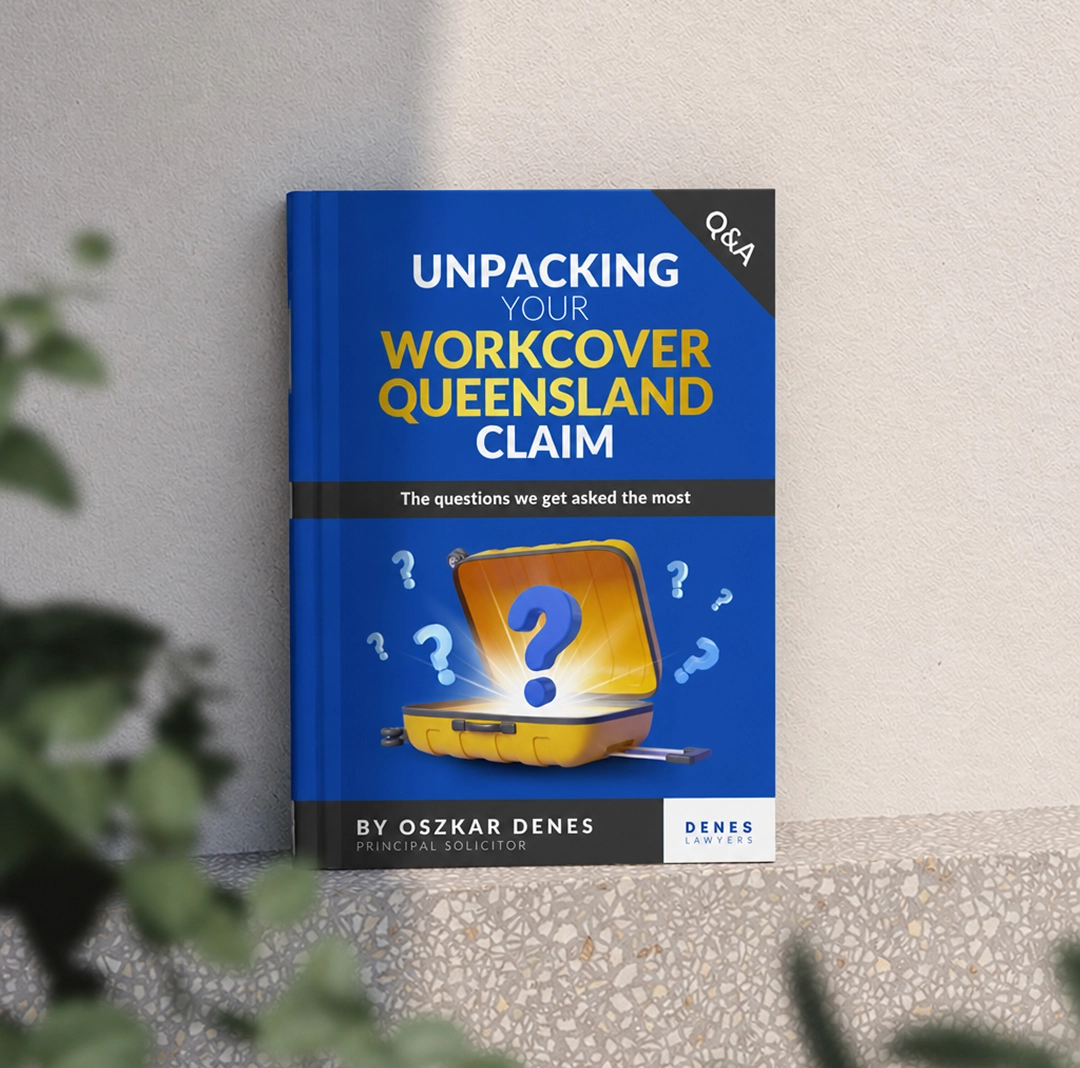
Free book: what to expect when you make a workers' compensation claim in Queensland
If you have been injured in a work accident in Queensland, understanding your rights and the WorkCover process can feel overwhelming.
Our free hard copy book, Unpacking Your WorkCover Queensland Claim, gives you clear, practical guidance. It covers many of the questions we get asked, including:
- What are the steps in a workcover claim?
- Statutory claim vs common law claim
- What if the claim is rejected?
- What to do if the impairment assessment result is too low
- Common law claim process
- Our No Win No Fee agreement
Fill out the form below to receive your free copy. You don’t need to be a client to receive a copy.
Every client and case is unique—we’re here to help you make the right legal decisions.
Prefer to speak with someone directly?
Call us on (07) 3063 2268 and we’ll be happy to discuss your matter.
Contact us
Just fill out the form below. Please remember: anything you share with us is strictly confidential and will never be disclosed to anyone without your consent.
"*" indicates required fields