
Many workers assume they cannot claim workers’ compensation if they already had a medical condition before the workplace injury. In Queensland, that is not necessarily true.
Can you claim workers’ compensation for a pre-existing injury in Queensland?
Yes, in Queensland, Workers’ compensation can still apply if a workplace incident made a pre-existing condition worse. In some cases, you may also be able to bring a common law damages claim against your employer.
This article explains how pre-existing conditions are treated in workers’ compensation claims.
Key points
- Workers’ compensation can still apply if a workplace injury aggravates a pre-existing condition.
- A work incident may cause a new injury, worsen an existing condition, or make a previously painless condition become painful.
- WorkCover sometimes argues that ongoing symptoms are due to the underlying condition rather than the work injury.
- Even with a pre-existing condition, workers may still recover significant common law damages.
- How our 25% fee cap helps you maximise your compensation
What is a pre-existing condition?
A pre-existing condition is a health problem you already had before the workplace injury happened. It can include:
- Physical injuries
- Degenerative conditions
- Psychological injuries
One very common example is degenerative changes in the spine, such as lumbar spondylosis. As people age, it is normal for some degeneration to appear in the spine, even if there are no symptoms at all.
In fact, many people have spinal degeneration without realising it because it does not cause pain. We will use spinal degeneration as an example to illustrate how WorkCover can still cover pre-existing conditions
Aggravation or exacerbation of a pre-existing condition
Even as the condition of the spine naturally degenerates over the years, many people don’t feel any symptoms (other than maybe the occasional back ache). Then a workplace injury occurs, leading to acute pain. A workplace injury can affect a pre-existing condition in several ways:
1. A new injury
Sometimes the workplace incident causes a completely new injury. For example, a worker may suffer a lifting injury that causes an L4/5 disc bulge that did not previously exist. In this situation, the injury is clearly covered by workers’ compensation.
2. Aggravation of an existing condition
In other cases, the worker may already have had a minor disc bulge or degeneration. The workplace injury then makes the condition worse. For example, a small disc bulge may become larger after a lifting incident. This is known as an aggravation of a pre-existing condition, and it can still be covered by workers’ compensation.
3. A previously painless condition becomes painful
Sometimes a workplace incident does not cause a new structural injury but instead triggers pain in a previously symptom-free condition. For example, a worker may have had asymptomatic spinal degeneration before the workplace incident. After the injury, the degeneration becomes painful. This is often described as an exacerbation of a pre-existing condition and can also qualify for workers’ compensation.
Real case example: when WorkCover blames the pre-existing condition
Although workers’ compensation can cover pre-existing conditions, problems sometimes arise later in the claim. We summarise below a real case (with identifying details removed).
Our client worked in a physically demanding job. Prior to the workplace injury, she occasionally experienced back pain due to age-related degeneration, but for the most part she was pain-free and able to work normally.
In the period leading up to the injury she had been working increased hours. One day, while performing a particularly strenuous task, she felt sudden severe back pain. Medical scans later confirmed a disc protrusion.
WorkCover accepted the claim and funded surgery (a discectomy). The surgery itself was technically successful, but unfortunately our client’s pain continued.
After some time, WorkCover arranged for our client to attend an independent medical examination with one of their doctors.
The doctor agreed that the workplace incident had caused the disc protrusion. However, the doctor concluded that the protrusion had resolved and that the pain our client was still experiencing was now caused by her underlying degeneration, not the workplace injury.
On that basis, WorkCover closed the statutory claim.
However, we were still able to pursue a common law damages claim on our client’s behalf.
How pre-existing conditions affect damages
If your employer was negligent, you may be able to make a common law damages claim in addition to your workers’ compensation claim.
In many cases, the largest component of damages is future economic loss. This compensates you for income you may lose between now and retirement because of the injury.
For serious injuries, this amount can reach hundreds of thousands of dollars or more.
However, when a worker has a pre-existing condition, WorkCover often argues that damages should be reduced. Two common arguments are:
1. The injury was only temporary
WorkCover may argue that the workplace incident caused a temporary worsening of the condition, but that the injury has now resolved. They may claim the worker’s ongoing symptoms are due entirely to the pre-existing condition.
2. The condition would have worsened anyway
Another argument is that even if the workplace injury caused some damage, the pre-existing condition would eventually have deteriorated. WorkCover may argue that within a few years the worker would have suffered the same level of pain or disability even if the workplace injury had never happened.
These arguments can significantly reduce the value of a damages claim.
How we help clients with pre-existing conditions?
Cases involving pre-existing conditions often depend heavily on medical evidence.
At Denes Lawyers, we carefully investigate our clients’ medical history and obtain reports from experienced medical specialists. In many cases, doctors for WorkCover claim that a worker’s ongoing pain is entirely due to a pre-existing condition. However, with the right expert evidence it is often possible to show that the workplace injury played a significant role in the worker’s disability.
For example, in one case a WorkCover doctor argued that our client’s spinal degeneration would have become so severe that he would have stopped working anyway — even though he was still in his late 30s.
However, the specialists we engaged concluded that if the workplace injury had not occurred, the underlying degeneration would likely not have caused significant symptoms for at least 15 years. This evidence made a substantial difference to the outcome of the claim and the calculation of damages.
Speak with a workers’ compensation lawyer
If you had a pre-existing condition before your workplace injury, do not assume that you cannot claim compensation. Many successful workers’ compensation claims involve people who had some form of prior degeneration or medical condition.
If you would like advice about your situation, we offer a free consultation to discuss your options. In most cases that we accept, we can offer to cap our professional fees at 25% of your damages recovery.
Related content
Pre-existing conditions and WorkCover: Frequently Asked Questions
Can you claim WorkCover if you had a previous injury?
Yes. Workers’ compensation may still apply if the workplace incident aggravated or worsened the existing injury.
What if my condition was already degenerative?
Many people have degenerative conditions such as spinal degeneration without symptoms. If a workplace injury makes that condition painful or worse, it may still be covered by workers’ compensation.
Can WorkCover reduce damages because of a pre-existing condition?
They will try. In common law claims, WorkCover often argues that the worker’s disability is mainly due to the pre-existing condition or that the condition would have worsened anyway. Medical evidence is usually critical in resolving this issue.
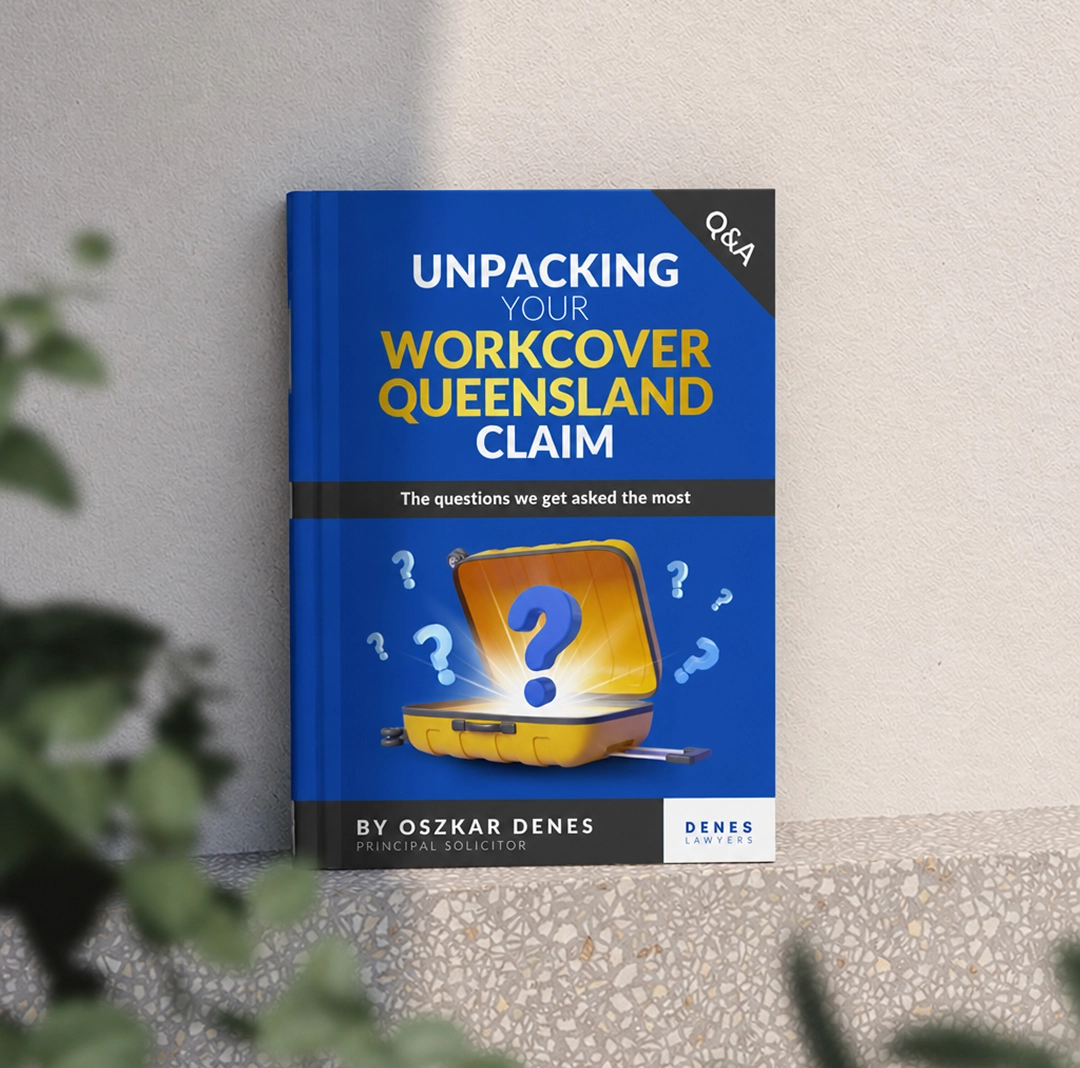
Free book: what to expect when you make a workers' compensation claim in Queensland
If you have been injured in a work accident in Queensland, understanding your rights and the WorkCover process can feel overwhelming.
Our free hard copy book, Unpacking Your WorkCover Queensland Claim, gives you clear, practical guidance. It covers many of the questions we get asked, including:
- What are the steps in a workcover claim?
- Statutory claim vs common law claim
- What if the claim is rejected?
- What to do if the impairment assessment result is too low
- Common law claim process
- Our No Win No Fee agreement
Fill out the form below to receive your free copy. You don’t need to be a client to receive a copy.
Every client and case is unique—we’re here to help you make the right legal decisions.
Prefer to speak with someone directly?
Call us on (07) 3063 2268 and we’ll be happy to discuss your matter.
Contact us
Just fill out the form below. Please remember: anything you share with us is strictly confidential and will never be disclosed to anyone without your consent.
"*" indicates required fields